Quick Answer: A job worker building bodies on chassis must include in the assessable value of the completed vehicle the full chassis value on which the manufacturer paid duty, which under Rule 8 of the Valuation Rules is 110% of cost. But the Department cannot invoke the extended period under the proviso to Section 11A when it already knew the chassis was cleared at 110%. The Supreme Court held that the demand for 01.11.2004 to 31.03.2007, raised by a show cause notice of 30.04.2008, was time-barred, and allowed the body builders' appeals.
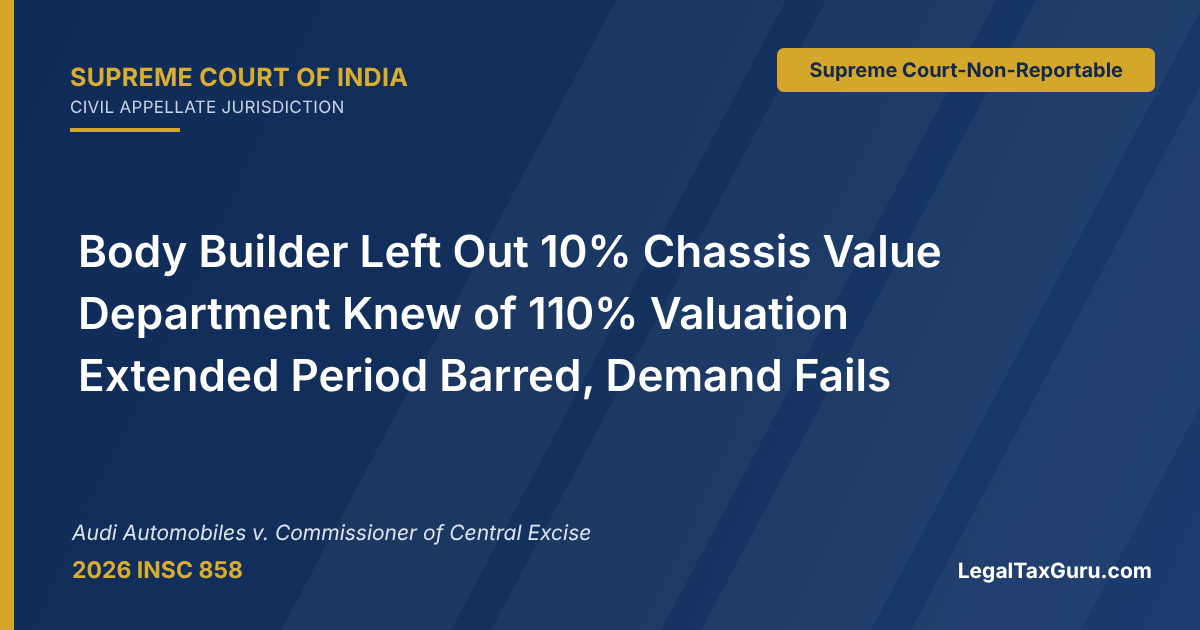
In Audi Automobiles & Ors. v. Commissioner of Central Excise and Service Tax, Indore (2026 INSC 858), the Supreme Court held that the 10% included in chassis value under Rule 8 of the Central Excise Valuation Rules, 2000 must form part of the assessable value of the body-built vehicle, applying Ujagar Prints (II) and (III) (paras 11–12, 17). However, since the manufacturer cleared the chassis at 110% of cost to the knowledge of the Department, there was no suppression, and the extended period under the proviso to Section 11A could not be invoked (para 16). A Bench of Justice J.B. Pardiwala and Justice K. Vinod Chandran set aside the orders of the Tribunal and the authorities below, as the show cause notice was beyond the one-year period (para 17).
Status: Order of the Tribunal (CESTAT), affirming the orders of the original and appellate authorities, set aside; demand held time-barred; appeals allowed (paras 17–18).
Headnote: Extended Limitation Under Section 11A and Body-Built Vehicles
Central Excise Act, 1944 – Section 11A and proviso – Extended period of limitation – Wilful suppression or misstatement – Facts known to Department – Section 35L – Maintainability of appeal on question relating to valuation – Central Excise Valuation (Determination of Price of Excisable Goods) Rules, 2000 – Rule 8 – Chassis valued at 110% of cost of manufacture – Job worker building bodies – Assessable value of completed vehicle – Ujagar Prints (II) and (III) applied – Continental Foundation followed.
Held: (i) The appeal is maintainable under Section 35L, as the limitation issue has an inextricable link with the value of goods for purposes of assessment, and the matter was not relegated to the High Court after almost a decade (para 4).
(ii) The matter was not in a flux; the Larger Bench of CESTAT in Eicher Motors only followed the Constitution Bench in Ujagar Prints (II) and (III) (paras 7, 12).
(iii) The 10% added to chassis value under Rule 8 must be included in the assessable value of the body-built vehicle, since duty was paid on it and credit utilised; only the manufacturer's post-manufacturing profit and expenses are excluded (paras 11–12).
(iv) Pawan Biscuits and General Engineering Works are distinguishable on facts (paras 9–11).
(v) Suppression or misstatement under the proviso to Section 11A must be wilful, with intent to evade duty, and when facts are known to both parties, an omission by one does not amount to suppression (paras 15–16).
(vi) As the Department knew the chassis was cleared at 110% of cost, the proviso could not be invoked, and the SCN dated 30.04.2008 for 01.11.2004 to 31.03.2007 was beyond the one-year period under Section 11A(1) (paras 16–17).
(paras 4–17)
Case Details: Audi Automobiles v. Commissioner of Central Excise (2026 INSC 858)
Final Outcome: Appeals allowed; orders of the Tribunal, the original authority and the appellate authority set aside; liability to include the full chassis value held unassailable, but not leviable for the period in question as the demand was time-barred.
Case: Audi Automobiles & Ors. v. Commissioner of Central Excise and Service Tax, Indore
Neutral Citation: 2026 INSC 858
Case No.: Civil Appeal Nos. 10504-10506 of 2017
Court: Supreme Court of India (Civil Appellate Jurisdiction) – Non-Reportable
Date of Decision: 13 August 2026
Bench: Justice J.B. Pardiwala and Justice K. Vinod Chandran (author)
Relevant Acts & Sections: Central Excise Act, 1944 – Sections 11A(1) and proviso, and 35L; Central Excise Valuation (Determination of Price of Excisable Goods) Rules, 2000 – Rule 8; CENVAT credit
Impugned Order(s): Order of the Tribunal (CESTAT) affirming the orders of the original authority and the appellate authority; the judgment does not give its date (para 17)
Counsel: Ms. Charanya Lakshmikumaran, AoR, for the appellants; Ms. Nisha Bagchi, Senior Counsel, for the respondent-Department (para 2)
Source: Supreme Court of India (official website)
Key Holdings of the Supreme Court
- An appeal on the extended period of limitation is maintainable under Section 35L where the issue is inextricably linked to valuation for assessment (para 4).
- The assessable value of a body-built vehicle must include the chassis value at 110% of cost under Rule 8, along with raw materials, job charges and the job worker's profit (paras 5, 11–12).
- What is excluded is only the manufacturer's anticipated profit on sale of the completed vehicle and its expenses after receiving it from the job worker (para 11).
- The law was not in a flux, as Ujagar Prints (II) and (III) applied squarely (para 12).
- Extension of limitation has civil and criminal consequences, and the grounds must be specifically stated in the SCN (para 14).
- Only wilful suppression or misstatement with intent to evade duty permits the extended period (para 15).
- Where facts are known to both sides, an omission by the assessee is not suppression, and the Department must act within the normal period (para 16).
Brief Facts of the Case
The appellants build bodies on motor vehicle chassis as job work. Manufacturers send them the chassis after paying excise duty on its value under Rule 8 of the Valuation Rules, 2000, which is 110% of the cost of manufacture (para 5).
After building the body, the appellants return the completed vehicle and pay duty, after availing CENVAT credit, on the cost of the chassis, raw materials, job charges and their profit. They computed the chassis component on its actual cost of manufacture, without the additional 10%, which they said represented the manufacturer's profit (para 5).
The question was whether this 10% could be deducted. A show cause notice dated 30.04.2008 raised a demand for 01.11.2004 to 31.03.2007 by invoking the extended period, and the original authority, appellate authority and Tribunal ruled against the appellants (paras 13, 17).
Before the Supreme Court, the Department raised a preliminary objection that the appeals did not fall under Section 35L, relying on SAIL v. Directorate General of Anti-Dumping and Commissioner of Customs v. Motorola (India) Ltd. (para 3).
Issues Before the Supreme Court
- Whether the appeals are maintainable under Section 35L of the Central Excise Act, 1944 (paras 3–4).
- Whether the 10% added to the chassis value under Rule 8 must be included in the assessable value of the body-built vehicle (paras 5, 11–12).
- Whether the extended period of limitation under the proviso to Section 11A was available to the Department (paras 1, 13–16).
Court's Findings and Reasoning
Maintainability under Section 35L (paras 3–4): The Court held that the limitation issue, founded on the claim that the assessee did not wilfully suppress the valuation of the body-built vehicle, is inextricably linked to the value of goods for assessment. Though the assessee could have gone to the High Court, the Court declined to relegate the matter after almost a decade.
Was the law in a flux? (paras 6–7): The assessee argued that the issue was unsettled after Ujagar Prints (II) and (III) until the CESTAT Larger Bench decision in Eicher Motors. The Court disagreed, noting that the Larger Bench only followed the Constitution Bench decisions, which had answered a reference from Empire Industries.
Precedents cited by the assessee distinguished (paras 8–11): Pawan Biscuits concerned biscuits made on job work for Britania, where Britania's post-manufacture profit and expenses were excluded, and General Engineering Works concerned scrap value. Neither was comparable to a chassis cleared at 110% of cost.
10% must be included (paras 11–12): When the job worker returns the completed vehicle, the 10% must be included, since it has gone into the cost of the vehicle on which duty was paid and credit utilised. What is excluded is only the manufacturer's anticipated profit on sale of the vehicle and its later expenses. The CESTAT Larger Bench rightly rejected the assessee's arguments.
Law on extended limitation (paras 13–15): Relying on Larsen & Toubro, the Court noted that the reasons for invoking the extended period must be specifically stated in the SCN, given its civil and criminal consequences. Following Continental Foundation, it held that suppression or misstatement must be wilful, with intent to evade duty.
Facts known to the Department (para 16): Continental Foundation also held that when facts are known to both parties, an omission by one does not amount to suppression. The manufacturer cleared the chassis at 110% of cost, which the Department knew. If the 10% was not added at the job worker's clearance, the Department should have acted at once under sub-section (1), and the proviso could not be invoked.
Demand time-barred (para 17): The SCN dated 30.04.2008 for the period 01.11.2004 to 31.03.2007 was beyond the one-year period under Section 11A(1). The liability to include the full chassis value is unassailable, but for the subject period it is not leviable because limitation had run against the revenue.
Final Outcome and Directions
- Orders of the Tribunal, the original authority and the appellate authority set aside (para 17).
- Assessee's liability to include the entire chassis value on which the manufacturer paid duty held unassailable, but not leviable for the subject period due to limitation (para 17).
- Appeals allowed; pending applications disposed of (paras 18–19).
Legal Principle Laid Down
A job worker building bodies on chassis must include in the assessable value of the completed vehicle the full chassis value on which the manufacturer paid duty, including the 10% added under Rule 8 of the Valuation Rules. But the extended period under the proviso to Section 11A of the Central Excise Act can be invoked only for wilful suppression or misstatement with intent to evade duty. Where the relevant facts are already known to the Department, the assessee's omission is not suppression, and a demand beyond the normal period is time-barred.
Precedents Relied Upon
- Ujagar Prints (II) v. Union of India, (1989) 3 SCC 488, and Ujagar Prints (III) v. Union of India, (1989) 3 SCC 531 – Applied – valuation of goods processed on job work (paras 6–7, 11–12).
- Continental Foundation Joint Venture Holding v. CCE, (2007) 10 SCC 337 – Followed – suppression must be wilful; no suppression when facts are known to both parties (paras 15–16).
- Larsen & Toubro Ltd. v. CCE, (2007) 9 SCC 617 – Relied upon – grounds for extended period must be stated in the SCN (para 14).
- CCE v. Kolety Gum Industries, (2018) 12 SCC 245 – Cited on extended limitation (para 13).
- Eicher Motors Ltd. v. CCE, Indore, 2008 (228) E.L.T. 43 (CESTAT, Larger Bench) – Approved on valuation (paras 6–7, 12).
- Empire Industries v. Union of India, 1985 (20) ELT 179 (SC) – Referred to (para 7).
- Pawan Biscuits Co. Pvt. Ltd. v. CCE, (2000) 6 SCC 489, and General Engineering Works v. CCE, 2007 (212) E.L.T. 295 (SC) – Distinguished on facts (paras 8–11).
- SAIL v. Directorate General of Anti-Dumping & Allied Duties, (2017) 13 SCC 1, and Commissioner of Customs v. Motorola (India) Ltd., (2019) 9 SCC 563 – Relied on by the Department on maintainability; objection rejected (paras 3–4).
Important Paragraphs of the Judgment
Verbatim extracts from the judgment. For the full text, refer to the judgment PDF below.
Para 4: "In our opinion, the issue raised has an inextricable link with the value of goods for purposes of assessment, despite the same being held against the assessee and the controversy is also with respect to the extended period of limitation."
Para 12: "When the job worker computes excise duty on the deemed sale, at its gate, that 10% has to be included since it has gone into the cost of the vehicle on which excise duty is already paid and credit utilised. Hence, we are not inclined to find that the matter was in a flux, since the Constitution Bench decision applied squarely."
Para 15: "Therefore, there cannot be a suppression or misstatement of fact, which is not wilful and yet constitute a permissible ground for invocation of proviso to Section 11-A."
Para 16: "In the instant case, we already noticed that the manufacturer cleared the chassis at 110% of its cost of manufacture, which was known to the Department. Hence, if 10% was not added when computing the duty at the time of clearance by the job worker, the department ought to have taken immediate action under sub-section (1). The proviso cannot be invoked to extend the period of limitation."
Para 17: "The demand raised was for the period 01.11.2004 to 31.03.2007. The SCN dated 30.04.2008 was beyond the one-year period provided under Section 11-A (1)."
Para 18: "The appeals are allowed."
Practical Impact of the Ruling
- For body builders and job workers: The full value on which the manufacturer paid duty, including the Rule 8 uplift, must go into the assessable value of the finished goods (paras 11–12, 17).
- For assessees facing extended-period notices: Where the Department already knew the relevant facts, such as the manufacturer's 110% valuation, the extended period cannot be invoked (para 16).
- For the Department: If short payment is apparent from facts it knows, it must act within the normal period under Section 11A(1) (paras 16–17).
- For drafting show cause notices: Grounds for invoking the extended period must be specifically stated (para 14).
- For appeals under Section 35L: A limitation dispute closely tied to valuation can be heard directly by the Supreme Court (para 4).
FAQs on Extended Limitation Under Section 11A
1. What did the Supreme Court hold in Audi Automobiles v. Commissioner of Central Excise?
It held that the 10% chassis value must be included in the body-built vehicle's assessable value, but the demand was time-barred because the extended period could not be invoked, and allowed the appeals (paras 12, 16–18).
2. Why is the 10% chassis value includable?
Under Rule 8 the chassis is valued at 110% of cost, the manufacturer pays duty on it, and that value goes into the cost of the completed vehicle on which credit is utilised (paras 5, 12).
3. When can the extended period under Section 11A be invoked?
Only for fraud, collusion, or wilful misstatement or suppression of facts, or contravention with intent to evade duty (para 15).
4. Why was there no suppression in this case?
The Department knew the manufacturer cleared the chassis at 110% of cost, and when facts are known to both parties an omission by one is not suppression (para 16).
5. Was the appeal maintainable under Section 35L?
Yes. The Court held that the limitation issue was inextricably linked to the value of goods for assessment (para 4).
Keywords: 2026 INSC 858, Audi Automobiles v. Commissioner of Central Excise, Section 11A Central Excise Act, extended period of limitation, wilful suppression, facts known to Department, Rule 8 Valuation Rules 2000, 110% cost of manufacture, body building job work, chassis valuation, Ujagar Prints, Continental Foundation, Eicher Motors, Section 35L, CENVAT credit, Justice J.B. Pardiwala, Justice K. Vinod Chandran, Supreme Court non-reportable judgment, central excise
Related on LegalTaxGuru
Download Judgment PDF – Audi Automobiles v. Commissioner of Central Excise
Source: Supreme Court of India (official website).