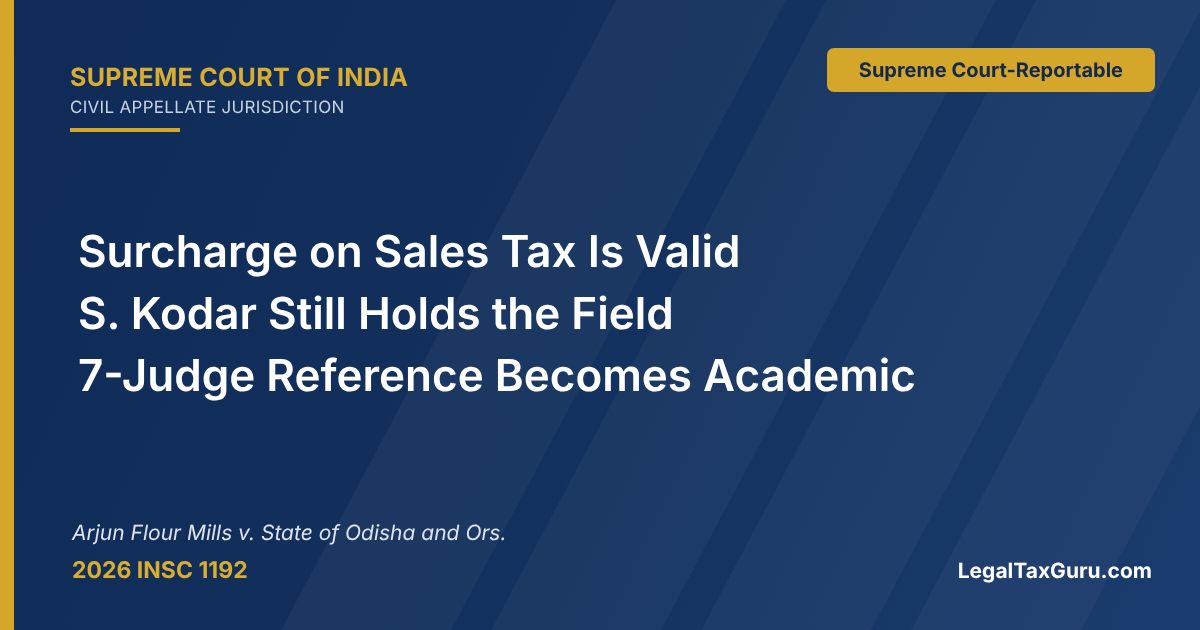
Quick Answer: A surcharge or additional tax calculated as a percentage of the sales tax payable is still a tax on the sale or purchase of goods under Entry 54 of List II, not an impermissible "tax on tax" or a tax on income. A seven-judge Bench of the Supreme Court held that S. Kodar v. State of Kerala continues to hold the field, that the perceived conflict with India Cement has disappeared after the Nine Judge Bench in Mineral Area Development Authority, and that the 1998–1999 reference had become academic. The Orissa and Punjab sales tax surcharge cases go back to regular Benches.
In Arjun Flour Mills v. State of Odisha (2026 INSC 1192), a seven-judge Bench of the Supreme Court held that the reference on whether a State can levy a surcharge computed on the sales tax payable does not survive, because S. Kodar v. State of Kerala squarely holds that such a levy is a tax on the sale or purchase of goods under Entry 54 of List II and that decision continues to hold the field (paras 87, 94, 102). Chief Justice Surya Kant, writing for six judges, held that the conflict with India Cement Ltd. v. State of Tamil Nadu was more apparent than real and in any case ended when Mineral Area Development Authority overruled India Cement on royalty being a tax (paras 79–86); Justice K.V. Viswanathan, concurring, held that S. Kodar was correctly decided and needs no reconsideration (Viswanathan J., para 65).
Status: Reference answered as rendered infructuous; competence to levy the impugned surcharges governed by S. Kodar; validity of Section 30-AA of the Punjab General Sales Tax Act, 1948 and the Article 266 question under the Punjab Social Security Act, 2000 left open; matters to be listed before regular Benches (para 103).
Headnote: Surcharge on Sales Tax Under Entry 54 of List II
Constitution of India – Seventh Schedule – Entry 54 of List II (pre-GST) – Legislative competence of States – Surcharge or additional tax computed as a percentage of sales tax payable – "Tax on tax" – Tax on income – Orissa Sales Tax Act, 1947, Section 5-A – Punjab General Sales Tax Act, 1948, Sections 5(1-C) and 30-AA – Punjab Social Security Act, 2000 – Reference to larger Bench – When a reference ceases to survive – Article 145(3), Article 141 – Precedent.
Held: (i) A reference to a larger Bench is a step in the adjudication of the appeals and survives only so long as the doubt or conflict that occasioned it exists; once that doubt is authoritatively dispelled, the reference ceases to serve its purpose (paras 74–76).
(ii) The perceived conflict between Hoechst Pharmaceuticals and India Cement was more apparent than real: the two dealt with different levies under different entries, and India Cement turned on royalty being a subject outside State competence, not on the mode of computing a cess (paras 79–83).
(iii) Mineral Area Development Authority, a Nine Judge Bench decision, held that royalty is not a tax and overruled India Cement to that extent; no subsisting decision of equal or greater strength conflicts with S. Kodar (paras 84–86).
(iv) A surcharge computed as a percentage of sales tax payable is, arithmetically, a further percentage of the same turnover; its subject remains the sale or purchase of goods, and the measure of a tax does not determine its character (para 90).
(v) Such a surcharge is not a tax on income, since it is payable irrespective of profit or loss once turnover crosses the threshold (para 91).
(vi) With Entry 54 of List II substituted after GST and the State sales tax laws replaced, the question has no prospective significance; the reference has been rendered academic, and the Section 30-AA and Article 266 issues are left open (paras 95–103).
(paras 74–103)
Case Details: Arjun Flour Mills v. State of Odisha (2026 INSC 1192)
Final Outcome: Reference answered as rendered infructuous; S. Kodar governs the legislative competence question; residual questions left open; matters remitted for listing before regular Benches.
Case: Arjun Flour Mills v. The State of Odisha, Finance Department Secretary & Ors. (with connected matters)
Neutral Citation: 2026 INSC 1192
Case No.: Civil Appeal No. 8763 of 1994, with Civil Appeal Nos. 8909 of 1994, 7485 of 2001, 98 of 2003, 831–850 of 2003, 851 of 2003, 99 of 2003, 100 of 2003, 5046 of 2003, 5637 of 2008 and SLP (Civil) Nos. 22159–22180 of 2002
Court: Supreme Court of India (Civil Appellate Jurisdiction) – Reportable (Seven Judge Bench)
Date of Decision: 4 November 2026
Bench: Chief Justice Surya Kant (author of the main judgment), Justice S.V.N. Bhatti, Justice Joymalya Bagchi, Justice N.V. Anjaria, Justice Arun Palli and Justice V. Mohana; Justice K.V. Viswanathan (separate concurring judgment)
Relevant Acts & Sections: Constitution of India – Article 246, Article 246A, Article 145(3), Article 141, Article 266, Seventh Schedule List II Entry 54 (as it stood and as substituted by the Constitution (One Hundred and First Amendment) Act, 2016); Orissa Sales Tax Act, 1947 – Section 5-A; Punjab General Sales Tax Act, 1948 – Sections 5(1-C), 30-A and 30-AA; Punjab Social Security Act, 2000
Impugned Orders: Orissa High Court judgment upholding Section 5-A of the Orissa Act; Punjab and Haryana High Court judgments upholding Sections 5(1-C) and 30-AA of the Punjab Act and striking down the Punjab Social Security Act, 2000 (paras 7, 12, 14; Viswanathan J., para 3)
Counsel: Ms. Samapika Biswal, Advocate on Record, as nodal counsel (paras 55, 104)
Source: Supreme Court of India (official website)
Key Holdings of the Supreme Court
- The question referred, whether a levy calculated on a valid sales tax is beyond State competence, is fully answered by S. Kodar, which continues to hold the field (paras 87, 94).
- A surcharge computed on the tax payable is in substance an additional levy on turnover; the measure of a tax does not determine its character (para 90).
- The surcharge is not a tax on income, as it is payable even by a loss-making dealer whose turnover crosses the threshold (para 91).
- India Cement did not hold that every levy computed on another levy is beyond competence; its premise that royalty is a tax was overruled by Mineral Area Development Authority (paras 83–86).
- Neither the pending curative petition against Mineral Area Development Authority nor Section 9D of the MMDR Act (2026) affects the approval of S. Kodar (para 89).
- A reference ceases to survive once the doubt that occasioned it is dispelled; a Seven Judge Bench is a scarce institutional resource (paras 76–77).
- Validity of Section 30-AA of the Punjab Act and the Article 266 question under the Punjab Social Security Act, 2000 are left open for regular Benches (paras 99–101, 103).
Brief Facts of the Case
Section 5-A of the Orissa Sales Tax Act, 1947, inserted with effect from 01.07.1990, required every dealer with a gross turnover above Rs. 10 lakh to pay a surcharge of 10 per cent of the total tax payable. The assessees argued that, being computed on tax and not on turnover, it was a "tax on tax" outside Entry 54 of List II (paras 7–9).
Section 5(1-C) of the Punjab General Sales Tax Act, 1948 imposed a similar 10 per cent surcharge, and Section 30-AA made units exempted under Section 30-A liable to pay it. The Punjab and Haryana High Court upheld both (paras 10–12).
The Punjab Social Security Act, 2000 levied a cess calculated as a percentage of sales tax payable, earmarked for the Punjab Social Security Fund. The High Court struck it down, holding that the proceeds had to form part of the Consolidated Fund of the State under Article 266 first (paras 13–14).
On 13.08.1998, a Two Judge Bench saw a conflict between Hoechst Pharmaceuticals and India Cement and sought a larger Bench. On 06.10.1999, a Constitution Bench noted that S. Kodar, a Five Judge Bench decision upholding an identical levy, would need reconsideration, and referred the matter to seven judges (paras 51–53).
Issues Before the Supreme Court
- Whether, in view of developments after the orders dated 13.08.1998 and 06.10.1999, the question referred continues to survive for adjudication by a Seven Judge Bench (para 69).
- Whether a tax, surcharge or cess calculated on the basis of a valid sales tax is beyond the legislative competence of the State under Entry 54 of List II (paras 70, 87–94).
Court's Findings and Reasoning
When a reference survives (paras 71–78): Relying on Central Board of Dawoodi Bohra Community, the Court held that a reference is tethered to a genuine doubt or conflict that a smaller Bench cannot resolve. If that doubt is dispelled by a larger Bench, by an amendment or otherwise, answering the reference would merely restate settled law.
No real conflict (paras 79–83): Hoechst Pharmaceuticals dealt with a surcharge on sales tax under Entry 54 of List II, while India Cement dealt with a cess on royalty in a field covered by the MMDR Act. India Cement did not turn on the mode of computation and itself approved Guruswamy, under which a cess on an existing tax is judged like that tax.
Effect of Kesoram and Mineral Area Development Authority (paras 84–86): Since the Nine Judge Bench held royalty is not a tax and overruled India Cement on that point, the "tax on tax" premise is gone, and no decision of equal or greater strength conflicts with S. Kodar.
S. Kodar holds the field (paras 87–94): In S. Kodar, the additional tax was computed as a percentage of tax payable, exactly as here. A surcharge on sales tax is a further percentage of turnover, rises with turnover rather than income, and is payable even in a loss year; it is therefore a tax on sales, not on income. Hoechst's concession does not weaken this, as the binding authority is S. Kodar.
Altered constitutional landscape (paras 95–97): Entry 54 of List II now covers only petroleum products and alcoholic liquor, and the State sales tax Acts were replaced by VAT and then GST. The question has no prospective significance, but assessees' rights for past periods are to be decided by regular Benches.
Residual questions left open (paras 98–101): Whether Section 30-AA can impose a surcharge on units that pay no tax due to exemption, and whether cess proceeds could go straight to the Punjab Social Security Fund without passing through the Consolidated Fund under Article 266, are distinct questions left open.
Concurring opinion (Viswanathan J., paras 57–67): Justice K.V. Viswanathan held that S. Kodar and Hoechst are consistent, that India Cement had no real bearing, and that S. Kodar was correctly decided. He directed the Orissa and Punjab sales tax appeals to be placed before an appropriate Bench, and the Punjab Social Security Act appeals before a Division Bench.
Final Outcome and Directions
- The reference is answered as rendered infructuous; competence to levy the impugned surcharges is governed by S. Kodar (para 103(i)).
- The validity of Section 30-AA of the Punjab General Sales Tax Act, 1948 for exempted units, and whether Punjab Social Security Act cess proceeds could be credited directly to the Fund without forming part of the Consolidated Fund under Article 266, are left open (para 103(ii)).
- All other contentions on assessments, periods of levy and consequential reliefs are left open (para 103(iii)).
- The Registry is to list the lead and connected matters before appropriate regular Benches after directions from the Chief Justice on the administrative side (para 103(iv)).
Legal Principle Laid Down
A surcharge or additional tax levied on a class of dealers and computed as a percentage of the sales tax payable is a tax on the sale or purchase of goods under Entry 54 of List II (as it stood before GST), not a tax on tax or on income; the measure of a tax does not determine its character. A reference to a larger Bench survives only while the doubt or conflict that prompted it subsists, and becomes academic once that doubt is dispelled by a larger Bench or by constitutional change.
Precedents Relied Upon
- S. Kodar v. State of Kerala, (1974) 4 SCC 422 (Constitution Bench) – Followed – additional tax computed with reference to sales tax is a tax on sale of goods. Discussed at paras 87, 89–94; Viswanathan J., paras 1, 61–65.
- Hoechst Pharmaceuticals Ltd. v. State of Bihar, (1983) 4 SCC 45 – Followed – surcharge on sales tax is not a tax on income. Discussed at paras 80, 91–92.
- India Cement Ltd. v. State of Tamil Nadu, (1990) 1 SCC 12 (Seven Judge Bench) – Distinguished; premise that royalty is a tax overruled. Discussed at paras 79–85.
- State of West Bengal v. Kesoram Industries Ltd., (2004) 10 SCC 201 – Noted – "royalty is a tax" read as an inadvertent error. Discussed at paras 57–58, 84.
- Mineral Area Development Authority v. Steel Authority of India, (2024) 10 SCC 1 (Nine Judge Bench) – Applied – royalty is not a tax; India Cement overruled to that extent. Discussed at paras 59–61, 84–89.
- Central Board of Dawoodi Bohra Community v. State of Maharashtra, (2005) 2 SCC 673 (Constitution Bench) – Applied – principles governing references to larger Benches. Discussed at paras 72–74, 86.
- M/s Guruswamy & Co. v. State of Mysore, [1967] 1 SCR 548 – Approved in India Cement – a cess on an existing tax is judged like that tax. Discussed at para 82.
Important Paragraphs of the Judgment
Verbatim extracts from the judgment. For the full text, refer to the judgment PDF below.
Para 76: "Where the doubt has been authoritatively dispelled, in the interregnum, whether by a subsequent decision of a Bench of greater strength, by a legislative or constitutional amendment, or otherwise, the reference ceases to serve the purpose for which it was made."
Para 83: "It was a declaration that a levy on royalty, in the field occupied by the MMDR Act, was beyond the competence of the State Legislature."
Para 86: "The conflict which occasioned the reference, whether real or apparent, has ceased to exist."
Para 90: "To illustrate, a surcharge of 10 per cent upon a sales tax levied at the rate of 10 per cent of the turnover is, in substance, nothing but an additional levy of 1 per cent upon the turnover."
Para 91: "A levy which is payable irrespective of the existence of income, and which bears no relation to the quantum of income, cannot, by any stretch, be characterised as a tax on income."
Para 65 (K.V. Viswanathan, J.): "For the reasons stated above, it is held that, S. Kodar (supra) has been correctly decided, continues to be a good law and needs no reconsideration."
Practical Impact of the Ruling
- For assessees with legacy sales tax disputes: Challenges to surcharges computed on sales tax as a "tax on tax" will fail on competence, as S. Kodar governs (paras 87, 103).
- For States: Past surcharge demands under the Orissa and Punjab Acts can be pursued, subject to individual issues left open (paras 97, 103).
- For exempted Punjab industrial units: The validity of Section 30-AA, which imposes a surcharge despite exemption, is still open and will be decided on merits (paras 99, 103).
- For public finance disputes: Whether earmarked cess proceeds must first pass through the Consolidated Fund under Article 266 is left for a regular Bench (paras 100, 103).
- For practitioners: Old references can be returned as academic where the conflict behind them has been settled by a larger Bench or overtaken by constitutional change (paras 76–78).
FAQs on Surcharge on Sales Tax and Entry 54
1. What did the Supreme Court decide in Arjun Flour Mills v. State of Odisha?
A seven-judge Bench held that the reference had become academic because S. Kodar already answers the question, and directed the matters to be decided by regular Benches under that law (paras 102–103).
2. Is a surcharge calculated on sales tax a "tax on tax"?
No. It is in substance a further percentage of turnover, so its subject is still the sale or purchase of goods; how the amount is computed does not change its character (para 90).
3. Is such a surcharge a tax on the dealer's income?
No. It is payable even by a dealer who makes a loss, so long as turnover crosses the threshold, and bears no relation to income (para 91).
4. Why did India Cement not create a conflict?
India Cement concerned a cess on royalty in a field occupied by the MMDR Act, and its premise that royalty is a tax was overruled by the Nine Judge Bench in Mineral Area Development Authority (paras 80–86).
5. What questions are still open?
The validity of Section 30-AA of the Punjab Act for exempted units, and the Article 266 question on the Punjab Social Security Act cess, along with individual assessment issues (para 103).
Keywords: 2026 INSC 1192, Arjun Flour Mills v. State of Odisha, surcharge on sales tax, tax on tax, Entry 54 List II, S. Kodar v. State of Kerala, Hoechst Pharmaceuticals, India Cement, Mineral Area Development Authority, Orissa Sales Tax Act Section 5-A, Punjab General Sales Tax Act Section 30-AA, Punjab Social Security Act, reference to larger bench, Chief Justice Surya Kant, seven judge bench, Supreme Court reportable judgment
Related on LegalTaxGuru
Download Judgment PDF – Arjun Flour Mills v. State of Odisha
Source: Supreme Court of India (official website).